Why Flow Cytometry Fails Outside the Lab: The Physics of Viscoelastic Focusing

  • PixCell Medical
  • 18 May 2026

Decentralized healthcare is largely dependent on bringing needed diagnostics closer to the patient. In hematology, the Complete Blood Count (CBC) with 5-part white blood cell differential is the cornerstone of clinical decision making, whether evaluating neutropenia in an oncology infusion center or identifying a serious infection in the primary care setting. But the transition of CBC testing from the central laboratory to the point-of-care (POC) or moderately complex physician office lab (POL) has been historically slow (Today’s Clinical Lab).

The culprit isn’t a lack of demand; it’s a limitation of physics.

For decades, leading hematology developers have been attempting to shrink down central-lab technology (i.e., traditional flow cytometry) to fit on a clinic desktop. But shrinking a machine does not change its fundamental physical dependencies and operational limitations. To understand why true near-patient hematology needs a completely new approach, we must examine the physics of fluid dynamics, the limitations of “hydrodynamic focusing,” and why a breakthrough called Viscoelastic Focusing (VEF) is the necessary paradigm shift.


The Bottleneck: The Physics of Hydrodynamic Focusing

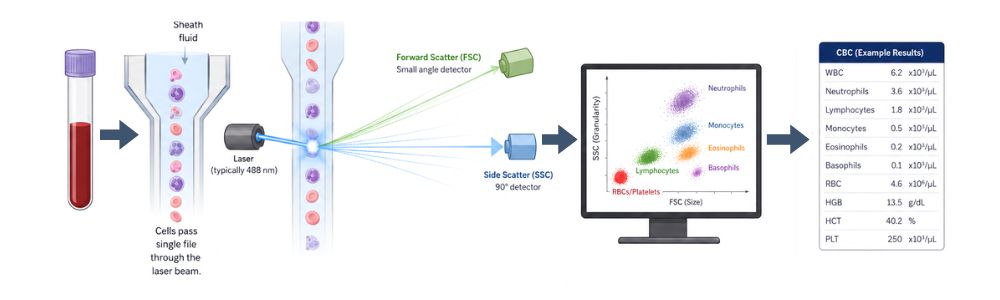
Traditional flow cytometry uses a principle called hydrodynamic focusing to analyze blood cells. Cells must pass through a laser interrogation point one by one to be accurately counted and differentiated (ACS).

To achieve this, the flow cytometer injects the blood sample stream into the center of a much faster-moving, larger volume of diluent, known as “sheath fluid.” Because the two fluids move at different velocities and pressures under laminar flow conditions, the sheath fluid forms a liquid tunnel that squeezes the inner core of the sample until the cells are forced into a single-file line.

This physical process is very effective in a temperature-controlled, stationary high-volume laboratory, but it creates severe vulnerabilities when deployed in a distributed clinical environment:

  • The Sheath Fluid Burden: Hydrodynamic focusing is “wet” by nature. It requires large continuous volumes of liquid reagents to maintain the sheath flow, even in the absence of any tests, for example, during priming, calibration, and cleaning cycles. For a low-volume clinic, this means paying for reagents that are literally flushed down the drain, requiring constant supply ordering, storage, and expensive biohazardous liquid waste disposal.
  • Clogging and Tubing Maintenance: The fluids must pass through microscopic apertures and complex internal tubing matrices to produce the necessary pressure differentials. Protein buildup, micro-clots, or cellular aggregation easily clog these pathways. This requires daily maintenance, back-flushing, and frequent service calls by specialized medical technologists, a luxury that most outpatient clinics do not have.
  • Optical Fragility and Vibration Sensitivity: Traditional flow cytometers depend on complex arrangements of lasers, lenses, and photomultiplier tubes for the collection of forward and side-scattered light. Because hydrodynamic focusing creates a narrow cylindrical core, the optical alignment must be exact. Any environmental vibration (such as in a mobile clinic, a naval vessel, or even a busy hospital corridor) can disrupt the delicate interrogation point, resulting in calibration failures and flagged results.
  • The “Blind” Classification Problem: Traditional flow cytometry and electrical impedance don’t actually see the cells they count; instead, they take indirect measurements. They shoot a laser at a cell and measure how the light scatters (to guess its internal complexity) or measure electrical resistance (to guess its size). This works well for perfectly healthy, standard cells, but it struggles profoundly with abnormalities. Atypical lymphocytes, immature bands, or clumped platelets can easily produce ambiguous light-scatter patterns. This “guesswork” leads to high false-positive flagging rates, meaning the machine cannot confidently classify the cell and forces the clinic to perform a manual, time-consuming microscope review anyway.
Traditional Flow Cytometry (Laser Scatter)


The Paradigm Shift: What is Viscoelastic Focusing (VEF)?

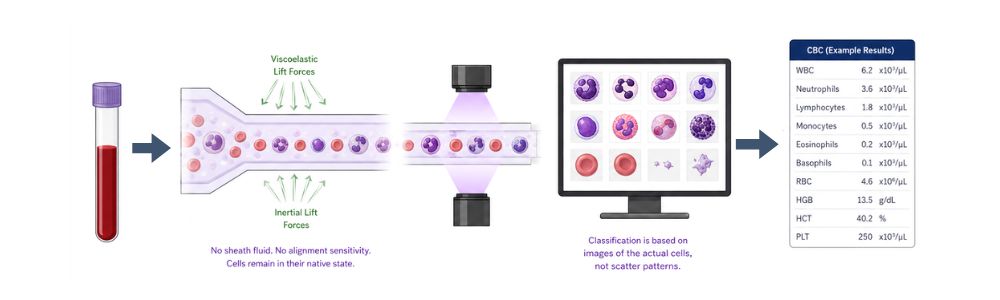
PixCell Medical abandoned hydrodynamic focusing altogether to address the structural failures of desktop hematology. Rather than using a secondary sheath fluid to physically manipulate the cells, PixCell leverages Viscoelastic Focusing (VEF), a novel physical phenomenon that occurs within microfluidics.

VEF employs a biocompatible viscoelastic polymer medium as opposed to a conventional Newtonian fluid (such as saline or water, which has a constant viscosity). Blood cells passing through a precisely engineered microfluidic channel in this viscoelastic medium are subjected to a unique set of physical forces.

In a typical fluidic micro-channel, the inertial lift forces act on the particles to move them away from the center. However, the addition of viscoelasticity introduces an opposing elastic lift force. When these forces synergize within a specific channel geometry, they drive the cells towards the absolute center of the flow (Sci Rep).

The result is profound. The viscoelastic forces naturally and predictably order the cells into a perfect single two-dimensional layer without the need for any surrounding sheath fluid.

Imaging Viscoelastic Focusing (VEF)


Why VEF is the Ultimate Solution for Decentralized Hematology

VEF replaces hydrodynamic mechanics with viscoelastic physics, eliminating the traditional barriers to desktop hematology. This translates directly to massive operational and economic advantages for the moderately complex lab:

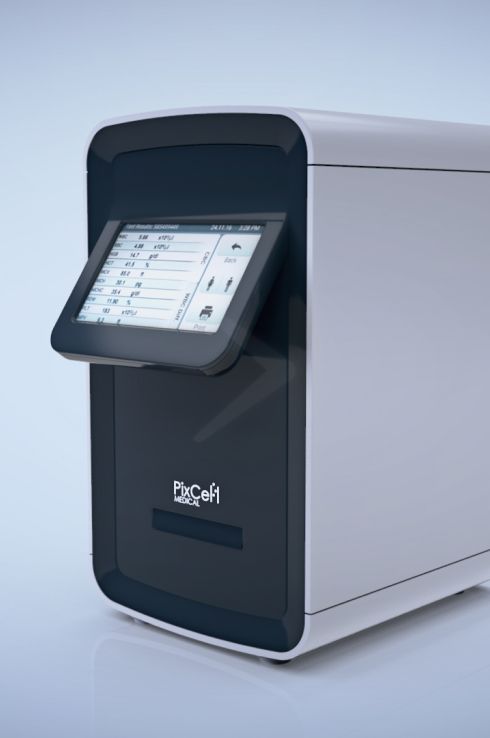
  • Sheathless Microfluidics and Zero Liquid Waste: VEF does not use any diluent or sheath fluid to align the cells, so the entire fluidic process can be miniaturized. With HemoScreen, all reagents are contained in one self-contained disposable cartridge. No heavy boxes of reagents to store, no priming cycles, and no liquid biohazard waste to deal with.
  • Absolute Clog Resistance: VEF achieves cell alignment through fluid physics rather than narrow physical apertures. The microfluidic channels used in VEF are significantly wider than traditional impedance or flow apertures, making them effectively clog-proof. In addition, the HemoScreen analyzer has no internal tubing, with all fluidics and reagents fully contained in the disposable cartridge, thus eliminating cross-contamination.
  • Vibration Independence: VEF organizes cells perfectly in a single flat 2D plane, allowing for high-resolution machine vision rather than scattered laser light. The analyzer captures rapid digital microscopic images of the cells as they flow. This direct imaging approach is vastly more robust, maintaining lab-grade accuracy even when subjected to the tilt or vibrations of an ambulance or maritime deployment.
  • Direct AI-Driven Morphology: Because Viscoelastic Focusing perfectly aligns every cell into a flat, stable 2D plane, HemoScreen can utilize high-resolution machine vision instead of relying on indirect light scatter. The AI examines the cell’s physical morphology, including nuclear lobulation, precise cell size, and cytoplasmic granulation. VEF visually identifies cells as a human hematopathologist would, reducing false-positive flags dramatically, and ensuring a higher degree of confidence in the 5-part differential. This is why the analyzer can accurately identify abnormal or immature cells that would be confusing for a traditional flow cytometer, significantly reducing the need for a manual smear.


The HemoScreen Advantage: AI-Driven Morphology

The real clinical power of Viscoelastic Focusing is fully realized when it is combined with artificial intelligence. By bringing into sharp focus each individual white blood cell, red blood cell, and platelet on a single plane, VEF enables true morphological analysis with advanced machine vision algorithms in the HemoScreen analyzer.

Rather than guessing a cell’s identity based on how it scatters light or disrupts an electrical current, HemoScreen actually sees the cell. The AI analyzes structural features like lobulation of the nucleus, cytoplasmic granulation, and the exact cell size. It effectively mimics the expertise of a human hematopathologist looking at a peripheral blood smear under a microscope, but with the speed and throughput of an automated analyzer.

The Bottom Line: Moving Beyond “Wet” Hematology

For years, clinics running moderate complexity labs have been forced to accept the hidden costs of “miniaturized” central lab equipment: the daily tech maintenance, the unavoidable reagent waste, and the inevitable downtime.

By fundamentally rethinking the physics of cell alignment, Viscoelastic Focusing removes the liquid complexity from the machine and places it into a simple, factory-calibrated “Lab-on-a-Cartridge.” The shift from hydrodynamic to viscoelastic focusing is much more than a simple engineering upgrade, it is the technological basis that finally makes highly accurate, zero-maintenance, single-visit hematology a reality for the modern medical facility.


(*) Please note: training must be defined by local, state and federal regulations. In the USA, training is defined for CLIA moderate complexity devices.